

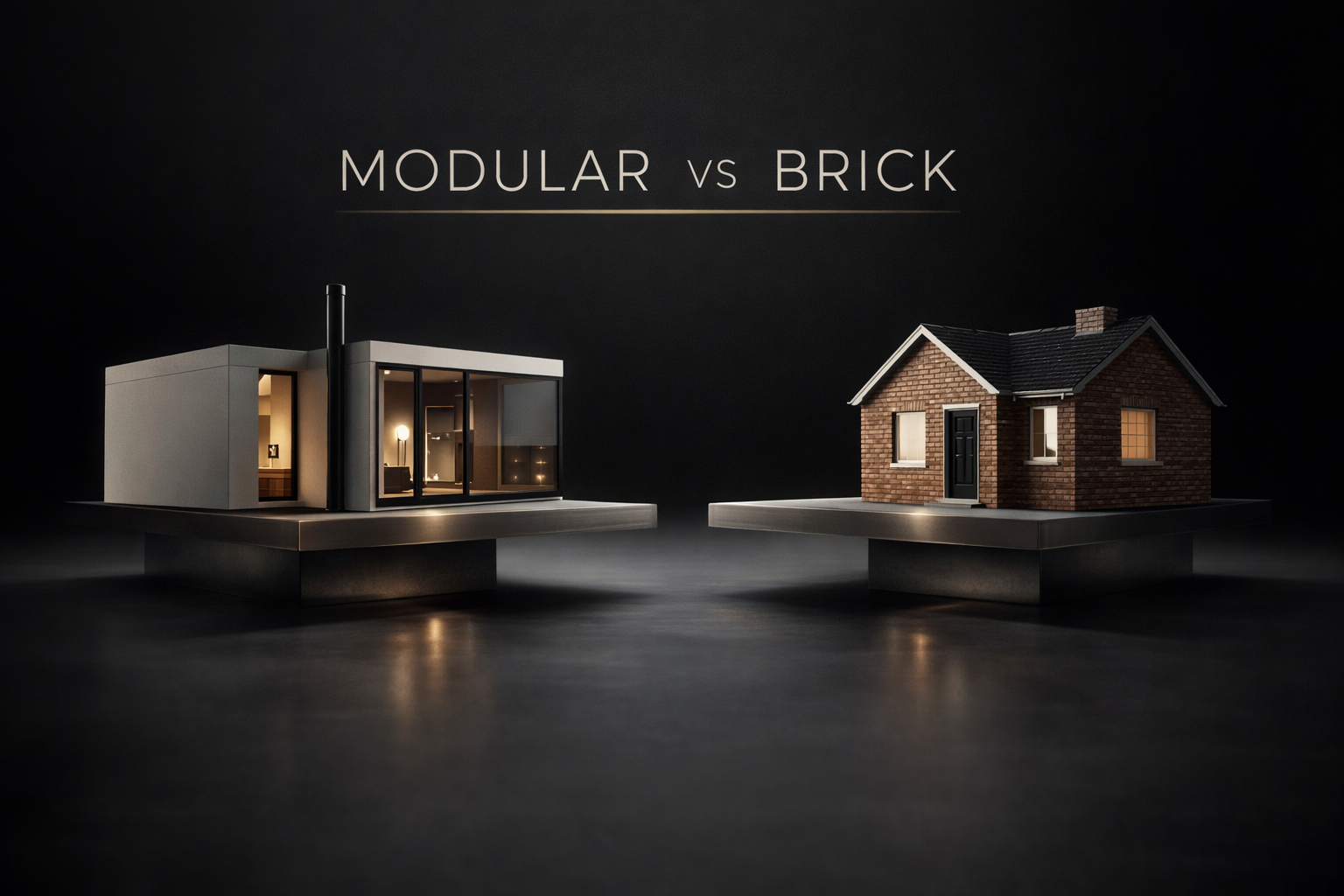
Modular or Traditional?
A Structural, Economic, and Environmental Investigation
By an investigative building systems analyst
For decades, brick-and-mortar construction has been perceived as the gold standard of permanence. Solid. Heavy. “Built to last.”
But when examined through the lens of structural engineering, financial efficiency, environmental performance, and long-term adaptability, a different story emerges.
The evidence increasingly shows that modular construction is not an alternative anymore — it is an evolution.
Let’s examine why.
1. Precision Engineering vs. On-Site Variables
Traditional brick construction is built entirely on-site. This means exposure to:
• Weather delays
• Moisture infiltration during construction
• Human inconsistency
• Variable material quality
• Extended curing times
Modular homes, by contrast, are built in controlled factory environments.
This controlled production delivers:
• Millimeter-level precision
• Reduced structural deviations
• Consistent insulation installation
• Controlled moisture conditions
• Quality checks at every stage
When structures are assembled under laboratory-like conditions instead of unpredictable outdoor sites, structural integrity improves dramatically.
This is not opinion. It is process control.
2. Structural Performance in Seismic and Climate Conditions
Brick structures rely on mass and rigidity. While strong in compression, they are brittle under lateral forces.
Modular homes typically use engineered timber, laminated wood, or steel framing systems that provide flexibility — a critical factor in seismic zones.
In earthquake-prone regions, lighter, flexible systems absorb and distribute energy more effectively than heavy masonry.
In extreme climates, modular wall systems often include:
• Multi-layer vapor barriers
• High-performance insulation (stone wool, PIR, EPS)
• Airtight membranes
• Thermal bridge reduction systems
The result is superior thermal performance and reduced structural cracking.
3. Construction Time: Months vs. Weeks
Time is not just a convenience. It is a cost multiplier.
Brick construction can take 8–14 months depending on size and conditions.
Modular homes are typically completed in 8–16 weeks.
Why?
Because:
• Site preparation and module production happen simultaneously
• There are no weather-related stoppages
• Dry construction systems eliminate curing delays
• Factory workflows optimize sequencing
Speed reduces:
• Labor costs
• Financing costs
• Inflation exposure
• Risk of price fluctuations
Time saved is capital preserved.
4. Cost Transparency and Budget Control
Traditional construction is infamous for “unexpected costs.”
Material price changes.
Labor shortages.
Extended timelines.
Design changes during construction.
Modular systems are engineered before production begins.
This means:
• Fixed production contracts
• Pre-calculated material quantities
• Minimal on-site improvisation
• Lower risk of cost overruns
Predictability is a structural advantage.
5. Energy Efficiency and Long-Term Operational Costs
Modern modular homes are designed around performance envelopes, not just walls.
High-performance modular systems often achieve:
• Passive house-level insulation values
• Reduced air leakage
• Lower heating and cooling demand
• 30–60% lower energy consumption
Brick walls alone do not provide insulation. They require additional systems to reach modern efficiency standards.
Modular homes integrate insulation into the structural system itself.
Efficiency is built in — not added later.
6. Environmental Impact and Waste Reduction
Traditional construction generates significant on-site waste.
Modular production:
• Optimizes material cutting
• Reduces scrap
• Enables recycling within factory systems
• Minimizes site disturbance
Studies consistently show that modular construction can reduce material waste by up to 50%.
In a world where sustainability is no longer optional, waste reduction is a measurable advantage.
7. Scalability and Replication
Brick construction is sequential and location-dependent.
Modular construction is scalable.
If one unit works, ten can be produced with identical quality.
If demand increases, production lines expand.
If designs improve, the entire system evolves.
This makes modular construction ideal for:
• Housing developments
• Resorts
• Worker accommodations
• Urban infill projects
• Remote builds
Scalability is industrial strength applied to housing.
8. Modern Perception vs. Old Assumptions
The skepticism toward modular homes often comes from outdated associations:
Temporary structures.
Low-cost prefabs from decades ago.
Thin walls and limited durability.
Today’s modular homes use:
• Laminated structural timber
• Engineered steel frames
• Fiber cement facades
• Stone wool insulation
• Advanced airtightness systems
They are not “temporary.”
They are engineered buildings manufactured with industrial precision.
Conclusion: The Structural Shift
Brick construction built the past.
Modular construction is building the future.
When measured by:
Structural precision
Energy performance
Speed
Cost control
Sustainability
Scalability
Modular systems consistently outperform traditional masonry in key categories that matter in the modern construction landscape.
The question is no longer whether modular homes are “as good as” brick.
The question is how long traditional construction can compete with industrialized precision.
The data suggests the shift is already underway.

No responses yet