

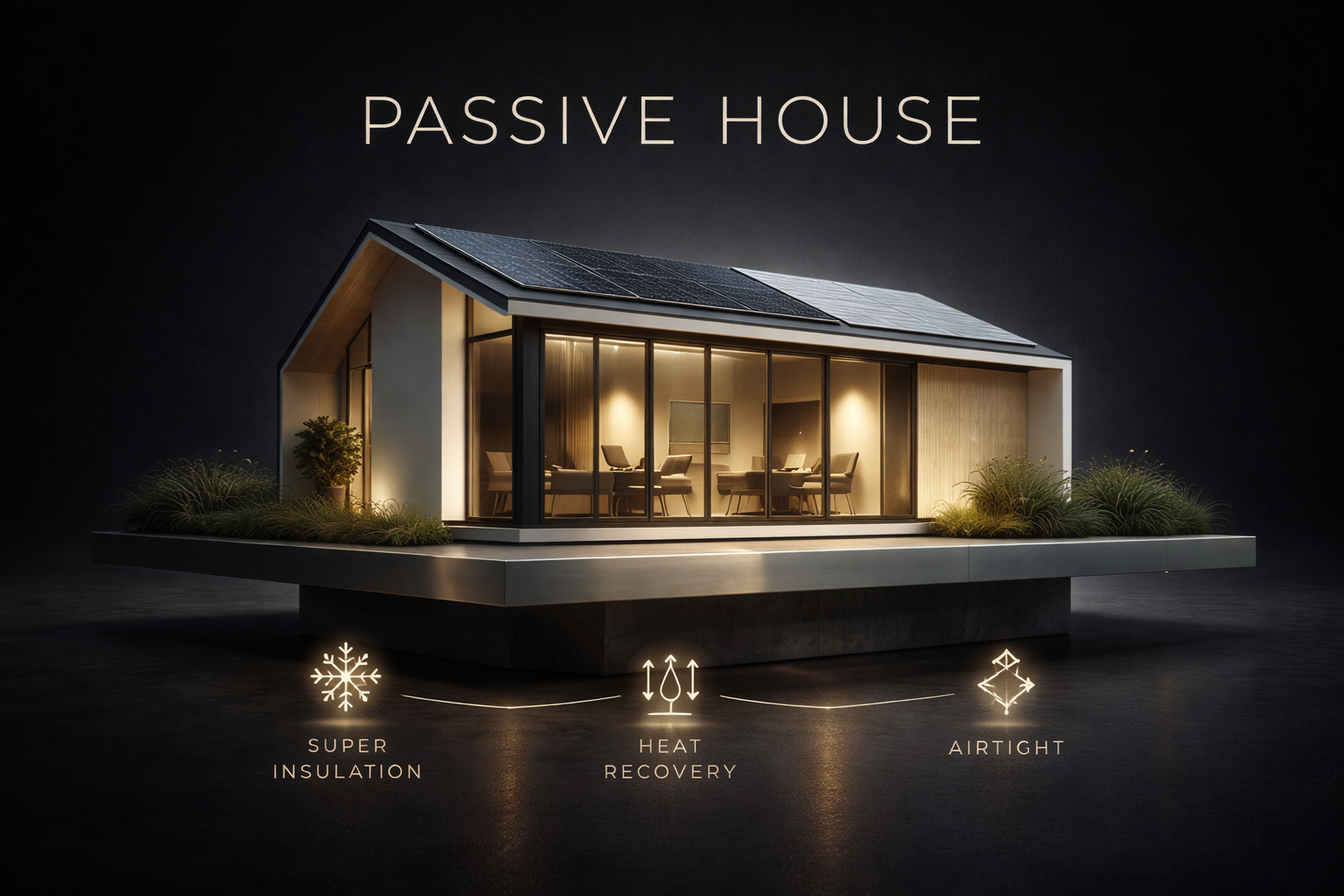
Introduction: A Quiet Revolution in Construction
For decades, the housing industry followed a predictable formula: build thicker walls, install stronger heating systems, and accept high energy bills as inevitable.
However, passive houses have fundamentally changed that equation.
Instead of consuming more energy, these buildings drastically reduce energy demand from the start. As a result, heating becomes minimal, cooling costs drop, and indoor comfort improves dramatically.
But what exactly makes passive houses different?
Let’s take a structured, evidence-based look.
What Is a Passive House?
A passive house (Passivhaus standard), developed in Germany in the early 1990s, is a building concept focused on reducing energy demand before producing energy.
According to the Passive House Institute (PHI), a certified passive house must meet strict performance criteria in terms of heating demand, airtightness, and primary energy use.
Unlike conventional homes, passive houses are not primarily about solar panels. Instead, they focus on reducing the need for energy through smart design and precise engineering.
That distinction is critical.
The Measurable Numbers Behind Passive Houses
Energy efficiency in passive houses is not marketing language. It is measurable physics.
According to the Passive House Institute in Darmstadt:
• Heating energy demand is reduced by up to 90% compared to conventional buildings
• Total primary energy consumption decreases by approximately 75%
• Annual heating demand is limited to 15 kWh per square meter
To understand the scale:
A conventional European home often uses between 120 and 200 kWh/m² per year for heating.
A passive house uses around 15 kWh/m².
Therefore, the difference is not incremental. It is structural.
The Five Core Principles of Passive House Design
1. Superinsulation
First, passive houses use high levels of thermal insulation in walls, roofs, and floors.
Lower U-values significantly reduce heat transfer. Consequently, indoor temperatures remain stable even in extreme weather.
2. Airtight Construction
Second, airtightness eliminates uncontrolled air leakage.
In conventional buildings, drafts cause substantial energy losses. In contrast, passive houses meet strict airtightness standards:
n50 ≤ 0.6 air changes per hour (verified via blower-door test).
As a result, energy loss is minimized while indoor air quality improves.
3. High-Performance Windows
Third, triple-glazed windows with insulated frames prevent heat loss while allowing solar gains.
Instead of acting as weak points, windows become active energy contributors during winter months.
4. Thermal Bridge-Free Design
Additionally, passive houses eliminate thermal bridges.
In traditional construction, heat escapes through balconies, corners, and slab connections. However, passive design carefully avoids these weak spots.
Consequently, condensation risks decrease and mold formation is prevented.
5. Heat Recovery Ventilation (HRV)
Finally, mechanical ventilation with heat recovery ensures continuous fresh air supply.
Outgoing warm air transfers its heat to incoming cold air. Modern HRV systems recover between 75% and 90% of heat.
Therefore, fresh air does not mean energy loss.
Comfort: The Hidden Advantage
Although energy savings attract attention, comfort often becomes the real benefit.
Passive houses provide:
• Stable indoor temperatures year-round
• No cold surfaces
• No drafts
• Constant filtered fresh air
• Reduced external noise
As a result, thermal comfort becomes engineered performance rather than a luxury feature.
Cost Analysis: Is It More Expensive?
Admittedly, passive houses can cost 5–10% more upfront, depending on region and construction method.
However, this initial investment must be viewed strategically.
Heating systems are smaller or sometimes unnecessary.
Energy bills are dramatically reduced.
Maintenance costs decrease.
Property value increases.
Moreover, as energy prices continue rising across Europe, long-term savings become even more significant.
For additional data on energy consumption trends, see Eurostat Energy Statistics.
Environmental Impact
Buildings account for approximately 40% of global energy consumption and CO₂ emissions.
Because passive houses reduce operational energy demand dramatically, they also lower carbon emissions.
When combined with renewable energy systems, such as photovoltaic panels, passive houses can approach net-zero energy performance.
Therefore, sustainability becomes measurable performance rather than branding language.
Passive vs Conventional Construction
Conventional houses compensate for inefficiency.
Passive houses eliminate inefficiency at the source.
One approach reacts to heat loss.
The other prevents it.
That difference defines the future of housing.
Why Passive Houses Matter for the Future
Across Europe, building regulations are becoming stricter.
Energy performance certificates now influence property value.
Carbon taxes are increasing.
Buyers are more informed.
As a result, passive-level construction is no longer luxury. It is future compliance.
Early adopters gain strategic advantage.
Final Perspective
Passive houses are not about trends. They are about physics, performance, and long-term logic.
They represent a shift:
From reactive heating to proactive design.
From energy consumption to energy control.
And in a world where energy defines economics, that shift is strategic.

No responses yet