

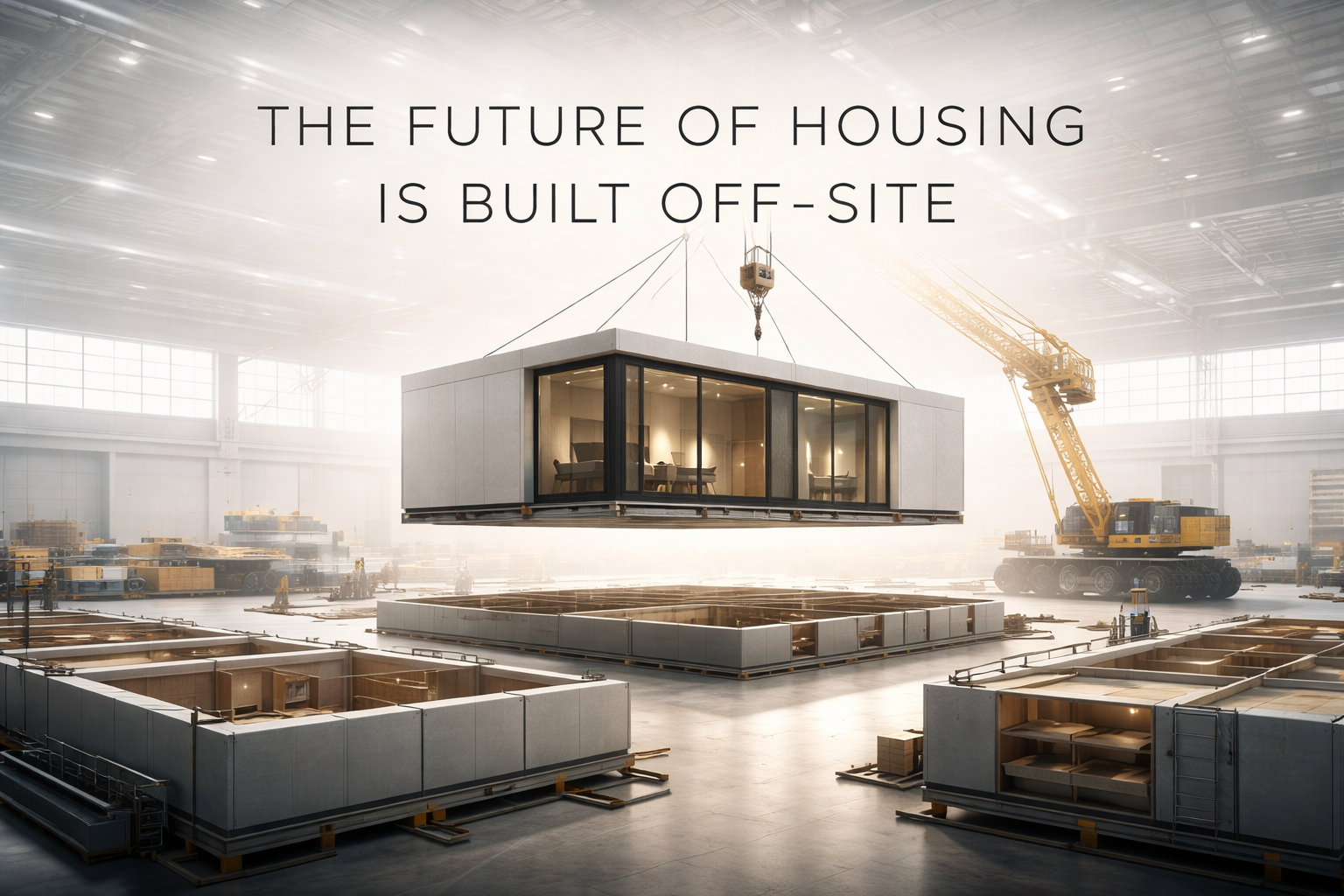
The Future of Housing Is Built Off-Site
For over a century, homes have been built the same way — brick by brick, exposed to weather, delays, and human inconsistency.
But the future of housing is built off-site.
Off-site construction, also known as modular construction, is redefining how we design, produce, and deliver modern homes. It is not a trend. It is an industrial transformation.
What Is Off-Site Construction?
Off-site construction refers to building structural components or entire housing modules in a controlled factory environment before transporting them to the final location for assembly.
Unlike traditional on-site building, factory-built homes offer:
• Controlled production conditions
• Precision engineering
• Reduced material waste
• Faster completion timelines
• Higher quality control
According to McKinsey & Company, construction productivity has lagged behind other industries for decades. Industrialized building systems are seen as the key solution:
https://www.mckinsey.com/industries/capital-projects-and-infrastructure/our-insights/reinventing-construction
Off-site construction introduces manufacturing logic into housing.
Why Modular Homes Are Gaining Global Momentum
The global modular construction market is projected to grow significantly over the next decade. Rising labor costs, urbanization, and sustainability demands are accelerating this shift.
Modular homes provide:
Speed — construction time reduced by up to 50%
Cost predictability — fixed production processes
Energy efficiency — integrated insulation systems
Scalability — repeatable, quality-controlled production
For global modular housing case studies, see:
https://www.archdaily.com/tag/modular-housing
The industry is evolving from experimental to mainstream.
Precision Through Factory Control
Traditional construction is vulnerable to:
Weather delays
Moisture damage during build
Material inconsistency
On-site human error
Off-site building systems eliminate many of these variables.
Factory-built homes are assembled under controlled conditions, ensuring:
Millimeter-level precision
Consistent insulation placement
Airtight envelopes
Reduced structural deviations
Precision is not a luxury. It is structural integrity.
Energy Performance and Sustainability
Modern modular homes are often designed around high-performance building envelopes.
This includes:
Thermal bridge minimization
High-performance insulation
Airtight construction
Heat recovery ventilation systems
The Passive House Institute demonstrates that optimized envelopes can reduce energy consumption by up to 90% compared to conventional buildings:
https://passivehouse.com/
Off-site construction allows these systems to be integrated systematically, not improvised on-site.
Reduced waste is another major benefit. Studies show that modular construction can reduce material waste by up to 50% compared to traditional building.
Sustainability is built into the process.
Economic Intelligence: Time Is Capital
Time in construction equals money.
Traditional homes may take 8–14 months to complete.
Modular homes can be delivered within 8–16 weeks depending on scale.
Simultaneous processes (site preparation + factory production) reduce:
Financing costs
Labor exposure
Inflation risks
Material price volatility
Predictability reduces financial risk.
Structural Resilience and Modern Materials
Off-site construction frequently uses:
Laminated timber (CLT / Glulam)
Steel framing systems
Fiber cement cladding
Stone wool insulation
These materials provide:
Seismic flexibility
Improved fire resistance
Enhanced thermal performance
Long-term durability
Explore how our structural system integrates these technologies:
[Internal Link – Construction Technology Page]
The Strategic Shift in Real Estate
Developers and investors increasingly prefer modular housing because it offers:
Scalable production
Standardized quality
Reduced project delays
Better ROI predictability
Urban housing shortages across Europe and globally are pushing governments toward faster construction methods.
Off-site construction is no longer optional. It is competitive advantage.
The Psychological Shift
Beyond engineering and economics, off-site housing represents a mindset change.
From reactive building
to engineered production
From uncertainty
to control
From traditional craft
to industrial precision
Housing is becoming a product — optimized, repeatable, refined.
Conclusion
The future of housing is not built slower.
It is built smarter.
Off-site construction combines precision, speed, sustainability, and economic logic into one integrated system.
Brick and mortar built the past.
Factory-built modular systems are building what comes next.

No responses yet